Showing posts with label rockabilly. Show all posts

Friday, August 14, 2015

Top 10 Greatest Rock Songs of 1950


Rock and roll (often written as rock & roll or rock 'n' roll) is a genre of popular music that originated and evolved in the United States during the late 1940s and early 1950s,[1][2] primarily from a combination of predominantly African-American genres such as blues, boogie woogie, jump blues, jazz, and gospel music,[3] together with Western swing and country music.[4]

Though elements of rock and roll can be heard in blues records from the 1920s[5] and in country records of the 1930s,[4] the genre did not acquire its name until the 1950s.[6][7]


The term "rock and roll" now has at least two different meanings, both in common usage: referring to the first wave of music that originated in the US in the 1950s and would later develop into the more encompassing international style known as "rock music", and as a term simply synonymous with the rock music and culture in the broad sense.[8]

For the purpose of differentiation, this article deals with the first definition.


In the earliest rock and roll styles of the late 1940s and early 1950s, either the piano or saxophone was often the lead instrument, but these were generally replaced or supplemented by guitar in the middle to late 1950s.[9]

The beat is essentially a blues rhythm with an accentuated backbeat, the latter almost always provided by a snare drum.[10] Classic rock and roll is usually played with one or two electric guitars (one lead, one rhythm), a string bass or (after the mid-1950s) an electric bass guitar, and a drum kit.[9]

Beyond simply a musical style, rock and roll, as seen in movies and on television, influenced lifestyles, fashion, attitudes, and language. In addition, rock and roll may have contributed to the civil rights movement because both African-American and white American teens enjoyed the music.[11]

It went on to spawn various genres, often without the initially characteristic backbeat, that are now more commonly called simply "rock music" or "rock".


Terminology


Sign commemorating the role of Alan Freed and Cleveland, Ohio in the origins of rock and roll


The term "rock and roll" now has at least two different meanings, both in common usage. The American Heritage Dictionary[12] and the Merriam-Webster Dictionary[13] both define rock and roll as synonymous with rock music.


Encyclopædia Britannica, on the other hand, regards it as the music that originated in the mid-1950s and later developed "into the more encompassing international style known as rock music".[14]


The phrase "rocking and rolling" originally described the movement of a ship on the ocean,[15] but was used by the early twentieth century, both to describe the spiritual fervor of black church rituals[16] and as a sexual analogy.


Various gospel, blues and swing recordings used the phrase before it became used more frequently – but still intermittently – in the 1940s, on recordings and in reviews of what became known as "rhythm and blues" music aimed at a black audience.[16]


In 1934, the song "Rock and Roll" by Boswell Sisters appeared in the film Transatlantic Merry-Go-Round.

In 1942, Billboard magazine columnist Maurie Orodenker started to use the term "rock-and-roll" to describe upbeat recordings such as "Rock Me" by Sister Rosetta Tharpe.[17]


By 1943, the "Rock and Roll Inn" in South Merchantville, New Jersey, was established as a music venue.[18]


In 1951, Cleveland, Ohio disc jockey Alan Freed began playing this music style while popularizing the phrase to describe it.[19]

Early rock and roll


Origins


The origins of rock and roll have been fiercely debated by commentators and historians of music.[20]


There is general agreement that it arose in the Southern United States – a region which would produce most of the major early rock and roll acts – through the meeting of various influences that embodied a merging of the African musical tradition with European instrumentation.[21]


The migration of many former slaves and their descendants to major urban centers such as Memphis, New York City, Detroit, Chicago, Cleveland and Buffalo (See: Second Great Migration (African American)) meant that black and white residents were living in close proximity in larger numbers than ever before, and as a result heard each other's music and even began to emulate each other's fashions.[22][23]


Radio stations that made white and black forms of music available to both groups, the development and spread of the gramophone record, and African American musical styles such as jazz and swing which were taken up by white musicians, aided this process of "cultural collision".[24]


Chuck Berry in 1957


The immediate roots of rock and roll lay in the rhythm and blues, then called "race music",[25] and country music of the 1940s and 1950s.[20]

Particularly significant influences were jazz, blues, gospel, country, and folk.[20]

Commentators differ in their views of which of these forms were most important and the degree to which the new music was a re-branding of African American rhythm and blues for a white market, or a new hybrid of black and white forms.[26][27][28]

In the 1930s jazz, and particularly swing, both in urban based dance bands and blues-influenced country swing, was among the first music to present African American sounds for a predominantly white audience.[27][29]

The 1940s saw the increased use of blaring horns (including saxophones), shouted lyrics and boogie woogie beats in jazz based music.

During and immediately after World War II, with shortages of fuel and limitations on audiences and available personnel, large jazz bands were less economical and tended to be replaced by smaller combos, using guitars, bass and drums.[20][30]

In the same period, particularly on the West Coast and in the Midwest, the development of jump blues, with its guitar riffs, prominent beats and shouted lyrics, prefigured many later developments.[20]

In the documentary film Hail! Hail! Rock 'n' Roll, Keith Richards proposes that Chuck Berry developed his brand of rock and roll, by transposing the familiar two-note lead line of jump blues piano directly to the electric guitar, creating what is instantly recognizable as rock guitar.

Similarly, country boogie and Chicago electric blues supplied many of the elements that would be seen as characteristic of rock and roll.[20]

Inspired by electric blues, Chuck Berry introduced an aggressive guitar sound to rock and roll, and established the electric guitar as its centrepiece,[31] adapting his rock band instrumentation from the basic basic blues band instrumentation of a lead guitar, second chord instrument, bass and drums.[32]

Rock and roll arrived at a time of considerable technological change, soon after the development of the electric guitar, amplifier and microphone, and the 45 rpm record.[20]

There were also changes in the record industry, with the rise of independent labels like Atlantic, Sun and Chess servicing niche audiences and a similar rise of radio stations that played their music.[20] 

It was the realization that relatively affluent white teenagers were listening to this music that led to the development of what was to be defined as rock and roll as a distinct genre.[20]


Bill Haley and his Comets performing in the 1954 Universal International film Round Up of Rhythm


Because the development of rock and roll was an evolutionary process, no single record can be identified as unambiguously "the first" rock and roll record.[33]


Contenders for the title of "first rock and roll record" include Goree Carter's "Rock Awhile" (1949);[34] Jimmy Preston's "Rock the Joint" (1949), which was later covered by Bill Haley & His Comets in 1952;[35] "Rocket 88" by Jackie Brenston and his Delta Cats (backed by Ike Turner and his band The Kings of Rhythm), recorded by Sam Phillips for Sun Records in March 1951.[36]


In terms of its wide cultural impact across society in the US and elsewhere, Bill Haley's "Rock Around the Clock",[37] recorded in April 1954 but not a commercial success until the following year, is generally recognized as an important milestone, but it was preceded by many recordings from earlier decades in which elements of rock and roll can be clearly discerned.[33][38][39]


Other artists with early rock and roll hits included Chuck Berry, Bo Diddley, Fats Domino, Little Richard, Jerry Lee Lewis, and Gene Vincent.[36]


Chuck Berry's 1955 classic "Maybellene" in particular features a distorted electric guitar solo with warm overtones created by his small valve amplifier.[40]


However, the use of distortion was predated by electric blues guitarists such as Joe Hill Louis,[41] Guitar Slim,[42] Willie Johnson of Howlin' Wolf's band,[43] and Pat Hare; the latter two also made use of distorted power chords in the early 1950s.[38]


Also in 1955, Bo Diddley introduced a new beat and unique electric guitar style,[44] heavily influenced by African music and in turn influencing many later artists.[45][46][47]

Rockabilly

Main article: Rockabilly


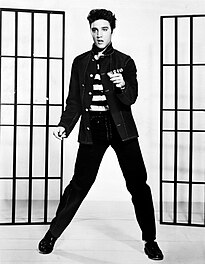
A black and white photograph of Elvis Presley standing between two sets of bars
Elvis Presley in a promotion shot for Jailhouse Rock in 1957


"Rockabilly" usually (but not exclusively) refers to the type of rock and roll music which was played and recorded in the mid-1950s primarily by white singers such as Elvis Presley, Carl Perkins, Johnny Cash, and Jerry Lee Lewis, who drew mainly on the country roots of the music.[48][49]


Many other popular rock and roll singers of the time, such as Fats Domino and Little Richard,[50] came out of the black rhythm and blues tradition, making the music attractive to white audiences, and are not usually classed as "rockabilly".


In July 1954, Elvis Presley recorded the regional hit "That's All Right" at Sam Phillips' Sun Studio in Memphis.[51]


Three months earlier, on April 12, 1954, Bill Haley & His Comets recorded "Rock Around the Clock". Although only a minor hit when first released, when used in the opening sequence of the movie Blackboard Jungle a year later, it set the rock and roll boom in motion.[37]


The song became one of the biggest hits in history, and frenzied teens flocked to see Haley and the Comets perform it, causing riots in some cities.


"Rock Around the Clock" was a breakthrough for both the group and for all of rock and roll music. If everything that came before laid the groundwork, "Rock Around the Clock" introduced the music to a global audience.[52]


In 1956, the arrival of rockabilly was underlined by the success of songs like "Folsom Prison Blues" by Johnny Cash, "Blue Suede Shoes" by Perkins and "Heartbreak Hotel" by Presley.[49]

For a few years it became the most commercially successful form of rock and roll. Later rockabilly acts, particularly performing songwriters like Buddy Holly, would be a major influence on British Invasion acts and particularly on the song writing of The Beatles and through them on the nature of later rock music.[53]

Doo wop

Main article: Doo wop


Doo wop was one of the most popular forms of 1950s rhythm and blues, often compared with rock and roll, with an emphasis on multi-part vocal harmonies and meaningless backing lyrics (from which the genre later gained its name), which were usually supported with light instrumentation.[54]


Its origins were in African American vocal groups of the 1930s and 40s, like the Ink Spots and the Mills Brothers, who had enjoyed considerable commercial success with arrangements based on close harmonies.[55]


They were followed by 1940s R&B vocal acts like The Orioles, The Ravens and The Clovers, who injected a strong element of traditional gospel and, increasingly, the energy of jump blues.[55]

By 1954, as rock and roll was beginning to emerge, a number of similar acts began to cross over from the R&B charts to mainstream success, often with added honking brass and saxophone, with The Crows, The Penguins, The El Dorados and The Turbans all scoring major hits.[55]


Despite the subsequent explosion in records from doo wop acts in the later 50s, many failed to chart or were one-hit wonders.


Exceptions included The Platters, with songs including "The Great Pretender" (1955)[56] and The Coasters with humorous songs like "Yakety Yak" (1958),[57] both of which ranked among the most successful rock and roll acts of the era.[55]


Towards the end of the decade there were increasing numbers of white, particularly Italian American, singers taking up Doo Wop, creating all-white groups like The Mystics and Dion and the Belmonts and racially integrated groups like The Dell Vikings and The Impalas.[55]


Doo wop would be a major influence on vocal surf music, soul and early Merseybeat, including The Beatles.[55]

Cover versions


Main article: Cover version


Many of the earliest white rock and roll hits were covers or partial re-writes of earlier black rhythm and blues or blues songs.[58]


Through the late 1940s and early 1950s, R&B music had been gaining a stronger beat and a wilder style, with artists such as Fats Domino and Johnny Otis speeding up the tempos and increasing the backbeat to great popularity on the juke joint circuit.[59]


Before the efforts of Freed and others, black music was taboo on many white-owned radio outlets, but artists and producers quickly recognized the potential of rock and roll.[60]


Most of Presley's early hits were covers of black rhythm and blues or blues songs, like "That's All Right" (a countrified arrangement of a blues number), "Baby Let's Play House", "Lawdy Miss Clawdy" and "Hound Dog".[61]


The racial lines however are rather more clouded by the fact that many of these R&B songs originally recorded by black artists had been written by white songwriters, such as the team of Jerry Lieber and Mike Stoller.


Rock and roller Little Richard performing in 2007


Covers were customary in the music industry at the time; it was made particularly easy by the compulsory license provision of United States copyright law (still in effect).[62]


One of the first relevant successful covers was Wynonie Harris's transformation of Roy Brown's 1947 original jump blues hit "Good Rocking Tonight" into a more showy rocker[63] and the Louis Prima rocker "Oh Babe" in 1950, as well as Amos Milburn's cover of what may have been the first white rock and roll record, Hardrock Gunter's "Birmingham Bounce" in 1949.[64]

The most notable trend, however, was white pop covers of black R&B numbers.


The more familiar sound of these covers may have been more palatable to white audiences, there may have been an element of prejudice, but labels aimed at the white market also had much better distribution networks and were generally much more profitable.[65]


Famously, Pat Boone recorded sanitized versions of Little Richard songs. Later, as those songs became popular, the original artists' recordings received radio play as well.[66]


The cover versions were not necessarily straightforward imitations. For example, Bill Haley's incompletely bowdlerized cover of "Shake, Rattle and Roll" transformed Big Joe Turner's humorous and racy tale of adult love into an energetic teen dance number,[58][67] while Georgia Gibbs replaced Etta James's tough, sarcastic vocal in "Roll With Me, Henry" (covered as "Dance With Me, Henry") with a perkier vocal more appropriate for an audience unfamiliar with the song to which James's song was an answer, Hank Ballard's "Work With Me, Annie".[68]

Elvis' rock and roll version of "Hound Dog", taken mainly from a version recorded by pop band Freddie Bell and the Bellboys, was very different from the blues shouter that Big Mama Thornton had recorded four years earlier.[69][70]

Decline


Buddy Holly and his band, The Crickets, were giants in the history of rock, and Holly's death was a musical inflection point.


Some commentators have suggested a decline of rock and roll in the late 1950s and early 1960s.[71][72]

By 1959, the death of Buddy Holly, The Big Bopper and Ritchie Valens in a plane crash (February 1959), the departure of Elvis for the army (March 1958), the retirement of Little Richard to become a preacher (October 1957), the scandal surrounding Jerry Lee Lewis' marriage to his thirteen-year-old cousin (May 1958)


The arrest of Chuck Berry (December 1959), and the breaking of the Payola scandal implicating major figures, including Alan Freed, in bribery and corruption in promoting individual acts or songs (November 1959), gave a sense that the initial phase of rock and roll had come to an end.[36]


There was also a process that has been described as the "feminisation" of rock and roll, with the charts beginning to be dominated by love ballads, often aimed at a female audience, and the rise of girl groups such as The Shirelles and The Crystals.[73]


Some music historians have pointed to important and innovative developments that built on rock and roll in this period, including multitrack recording, developed by Les Paul, the electronic treatment of sound by such innovators as Joe Meek, and the 'Wall of Sound' productions of Phil Spector,[74] continued desegregation of the charts, the rise of surf music, garage rock and the Twist dance craze.[27]


Surf rock in particular, noted for the use of reverb-drenched guitars, became one of the most popular forms of American rock of the 60s.[75]

British rock and roll


Tommy Steele, one of the first British rock and rollers, performing in Stockholm in 1957

Main article: British rock and roll

In the 1950s, Britain was well placed to receive American rock and roll music and culture.[76]


It shared a common language, had been exposed to American culture through the stationing of troops in the country, and shared many social developments, including the emergence of distinct youth sub-cultures, which in Britain included the Teddy Boys and the rockers.[77]


Trad Jazz became popular, and many of its musicians were influenced by related American styles, including boogie woogie and the blues.[78]


The skiffle craze, led by Lonnie Donegan, utilised amateurish versions of American folk songs and encouraged many of the subsequent generation of rock and roll, folk, R&B and beat musicians to start performing.[79]


At the same time British audiences were beginning to encounter American rock and roll, initially through films including Blackboard Jungle (1955) and Rock Around the Clock (1955).[80]

Both movies contained the Bill Haley & His Comets hit "Rock Around the Clock", which first entered the British charts in early 1955 – four months before it reached the US pop charts – topped the British charts later that year and again in 1956, and helped identify rock and roll with teenage delinquency.[81]


American rock and roll acts such as Elvis Presley, Little Richard, Buddy Holly, Chuck Berry and Carl Perkins thereafter became major forces in the British charts.


The initial response of the British music industry was to attempt to produce copies of American records, recorded with session musicians and often fronted by teen idols.[76] More grassroots British rock and rollers soon began to appear, including Wee Willie Harris and Tommy Steele.[76]

During this period American Rock and Roll remained dominant; however, in 1958 Britain produced its first "authentic" rock and roll song and star, when Cliff Richard reached number 2 in the charts with "Move It".[82]


At the same time, TV shows such as Six-Five Special and Oh Boy! promoted the careers of British rock and rollers like Marty Wilde and Adam Faith.[76]


Cliff Richard and his backing band, The Shadows, were the most successful home grown rock and roll based acts of the era.[83]


Other leading acts included Billy Fury, Joe Brown, and Johnny Kidd & The Pirates, whose 1960 hit song "Shakin' All Over" became a rock and roll standard.[76]


As interest in rock and roll was beginning to subside in America in the late 1950s and early 1960s, it was taken up by groups in major British urban centres like Liverpool, Manchester, Birmingham, and London.[84]


About the same time, a British blues scene developed, initially led by purist blues followers such as Alexis Korner and Cyril Davies who were directly inspired by American musicians such as Robert Johnson, Muddy Waters and Howlin' Wolf.[85]

Many groups moved towards the beat music of rock and roll and rhythm and blues from skiffle, like the Quarrymen who became The Beatles, producing a form of rock and roll revivalism that carried them and many other groups to national success from about 1963 and to international success from 1964, known in America as the British Invasion.[86]

Groups that followed The Beatles included the beat-influenced Freddie and the Dreamers, The Searchers, Wayne Fontana and the Mindbenders, Herman's Hermits and The Dave Clark Five, and more directly blues-influenced groups including The Animals, The Kinks, The Rolling Stones, The Who and The Yardbirds.[87]

As the blues became an increasingly significant influence, leading to the creation of the blues rock of groups like The Moody Blues, Small Faces, The Move, Traffic and Cream, and developing into rock music, the influence of early rock and roll began to subside.[86]

Cultural impact


Rock and roll influenced lifestyles, fashion, attitudes, and language.[88]


In addition, rock and roll may have contributed to the civil rights movement because both African-American and white American teens enjoyed the music.[11]


Many early rock and roll songs dealt with issues of cars, school, dating, and clothing. The lyrics of rock and roll songs described events and conflicts that most listeners could relate to through personal experience.


Topics such as sex that had generally been considered taboo began to appear in rock and roll lyrics.


This new music tried to break boundaries and express emotions that people were actually feeling but had not talked about. An awakening began to take place in American youth culture .[89]

Race

In the crossover of African American "race music" to a growing white youth audience, the popularization of rock and roll involved both black performers reaching a white audience and white performers appropriating African American music.[90] 


Rock and roll appeared at a time when racial tensions in the United States were entering a new phase, with the beginnings of the civil rights movement for desegregation, leading to the Supreme Court ruling that abolished the policy of "separate but equal" in 1954, but leaving a policy which would be extremely difficult to enforce in parts of the United States.[91]


The coming together of white youth audiences and black music in rock and roll inevitably provoked strong white racist reactions within the US, with many whites condemning its breaking down of barriers based on color.[11]


Many observers saw rock and roll as heralding the way for desegregation, in creating a new form of music that encouraged racial cooperation and shared experience.[92]


Many authors have argued that early rock and roll was instrumental in the way both white and black teenagers identified themselves.[93]

Teen culture


"There's No Romance in Rock and Roll" made the cover of True Life Romance in 1956
Main article: Youth subculture


Several rock historians have claimed that rock and roll was one of the first music genres to define an age group.[94]

It gave teenagers a sense of belonging, even when they were alone.[94] Rock and roll is often identified with the emergence of teen culture among the first baby boomer generation, who had both greater relative affluence, leisure and who adopted rock and roll as part of a distinct sub-culture.[95]


This involved not just music, absorbed via radio, record buying, jukeboxes and TV programs like American Bandstand, but it also extended to film, clothes, hair, cars and motorbikes, and distinctive language.


The contrast between parental and youth culture exemplified by rock and roll was a recurring source of concern for older generations, who worried about juvenile delinquency and social rebellion, particularly as to a large extent rock and roll culture was shared by different racial and social groups.[95]


In America, that concern was conveyed even in youth cultural artifacts such as comic books.


In "There's No Romance in Rock and Roll" from True Life Romance (1956), a defiant teen dates a rock and roll-loving boy but drops him for one who likes traditional adult music— to her parents' relief.[96]


In Britain, where post-war prosperity was more limited, rock and roll culture became attached to the pre-existing Teddy Boy movement, largely working class in origins, and eventually to the longer lasting rockers.[77]


Rock and roll has been seen as reorienting popular music towards a teen market, often celebrating teen fashions, as in Carl Perkins' "Blue Suede Shoes" (1956) or Dion and the Belmonts' "A Teenager in Love" (1960).[97]

Dance styles

From its early 1950s beginning through the early 1960s, rock and roll music spawned new dance crazes.[98]


Teenagers found the syncopated backbeat rhythm especially suited to reviving Big Band era jitterbug dancing.


"Sock hops", gym dances, and home basement dance parties became the rage, and American teens watched Dick Clark's American Bandstand to keep up on the latest dance and fashion styles.[99]


From the mid-1960s on, as "rock and roll" yielded gradually to "rock", later dance genres followed, starting with the twist, and leading up to funk, disco, house, techno, and hip hop.[100]

Source: Wikipedia.org

Somebody Come and Play in Traffic with Me! Earn as You Learn, Grow as You Go!

The Man Inside the Man
from
Sinbad the Sailor Man
A
JMK's Production


Share this page, If you liked It Pass it on, If you loved It Follow Me!


TTFN
CYA Later Taters!
Thanks for watching.
Donnie/ Sinbad the Sailor Man

Somebody Come and Play in "Traffic" with me. If you would like to "Join" A Growing Biz Op! Here is Your Chance to get in an Earn While You Learn to Do "The Thing" with us all here at Traffic Authority.


P.S. Everybody Needs Traffic! Get Top Tier North American Traffic Here!


Monday, July 27, 2015

Rick Nelson~ "It's Up To You"


Eric Hilliard Nelson (May 8, 1940 – December 31, 1985) – known as Ricky Nelson, later also as Rick Nelson – was an American actor, musician and singer-songwriter.

He starred alongside his family in the television series, The Adventures of Ozzie and Harriet (1952–66), as well as co-starring alongside John Wayne and Dean Martin in Howard Hawks's western feature film, Rio Bravo (1959).

He placed 53 songs on the Billboard Hot 100 between 1957 and 1973 including "Poor Little Fool" which holds the distinction of being the first #1 song on Billboard magazine's then-newly created Hot 100 chart.

He recorded 19 additional Top 10 hits and was inducted into the Rock and Roll Hall of Fame on January 21, 1987.[1][2] In 1996, he was ranked #49 on TV Guide's 50 Greatest TV Stars of All Time.[3]

Nelson began his entertainment career in 1949 playing himself in the radio sitcom series, The Adventures of Ozzie and Harriet. In 1952, he appeared in his first feature film, Here Come the Nelsons.

In 1957, he recorded his first single, debuted as a singer on the television version of the sitcom, and released the #1 album entitled Ricky.

In 1958, Nelson released his first #1 single, "Poor Little Fool", and in 1959 received a Golden Globe nomination for "Most Promising Male Newcomer" after starring in Rio Bravo.

A few films followed, and when the television series was cancelled in 1966, Nelson made occasional appearances as a guest star on various television programs.

Nelson and Sharon Kristin Harmon were married on April 20, 1963, and divorced in December 1982. They had four children: Tracy Kristine, twin sons Gunnar Eric and Matthew Gray, and Sam Hilliard.

On February 14, 1981, a son (Eric Crewe) was born to Nelson and Georgeann Crewe. A blood test in 1985 confirmed that Nelson was the child's father. Nelson was engaged to Helen Blair when both were killed in an airplane crash on December 31, 1985.

Yahoo Image Search: Ricky Nelson


Rick Nelson
A young man in profile playing a guitar and standing before a microphone.
Nelson in concert in Lawton, Oklahoma
Background information
Birth name Eric Hilliard Nelson
Born May 8, 1940
Teaneck, New Jersey, US
Died December 31, 1985 (aged 45)
De Kalb, Texas, US
Genres Rockabilly, Rock 'n' roll, Pop, Folk, Country
Occupation(s) Actor, musician, singer-songwriter
Years active 1949–1985
Labels Imperial, Decca/MCA, Epic
Associated acts Elvis Presley, The Everly Brothers, Fats Domino, Connie Francis, Carl Perkins, James Burton
Website rickynelson.com


Early life

Ricky Nelson was born on May 8, 1940, at 1:25 p.m. at Holy Name Hospital in Teaneck, New Jersey.[4][5][6] He was the second son of big band leader Ozzie Nelson, who was of half Swedish descent, and his wife, big band vocalist Harriet Hilliard Nelson (née Peggy Louise Snyder).

Harriett remained in Englewood, New Jersey, with her newborn and her older son David while Ozzie toured the nation with the Nelson orchestra.[7] T

he Nelsons bought a two-story colonial house in Tenafly, New Jersey,[7][8] and, six months after the purchase, moved with son David to Hollywood, where Ozzie and Harriet were slated to appear in the 1941–42 season of Red Skelton's The Raleigh Cigarette Hour; Ricky remained in Tenafly in the care of his paternal grandmother.[9]

In November 1941, the Nelsons bought what would become their permanent home: a green and white, two-story, Cape Cod colonial home at 1822 Camino Palmero in Los Angeles.[10][11]

 Ricky joined his parents and brother in Los Angeles in 1942.[10]

Ricky was a small and insecure child who suffered from severe asthma. At night, his sleep was eased with a vaporizer emitting tincture of evergreen.[12]

He was described by Red Skelton's producer John Guedel as "an odd little kid," likable, shy, introspective, mysterious, and inscrutable.[13]

When Skelton was drafted in 1944, Guedel crafted the radio sitcom The Adventures of Ozzie and Harriet for Ricky's parents.[13][14] The show debuted on Sunday, October 8, 1944, to favorable reviews.[15][16]

Ozzie eventually became head writer for the show and based episodes on the fraternal exploits and enmity of his sons.[17]

The Nelson boys were first played in the radio series by professional child actors until twelve-year-old Dave and eight-year-old Ricky joined the show on February 20, 1949, in the episode "Invitation to Dinner."[18][19]


The Nelson family, 1952


In 1952, the Nelsons tested the waters for a television series with the theatrically released film Here Come the Nelsons. The film was a hit, and Ozzie was convinced the family could make the transition from radio's airwaves to television's small screen.

On October 3, 1952, The Adventures of Ozzie and Harriet made its television debut and was broadcast in first run until September 3, 1966, to become one of the longest-running sitcoms in television history.

Education


Nelson attended Gardner Street Public School,[20] Bancroft Junior High,[21] and, between 1954 and 1958, Hollywood High School, from which he graduated with a B average.[22][23][24]

He played football at Hollywood High[22][23] and represented the school in interscholastic tennis matches.[25] Twenty-five years later, Nelson told the Los Angeles Weekly he hated school because it "smelled of pencils" and he was forced to rise early in the morning to attend.[22]

At Hollywood High, Nelson was blackballed by the Elksters, a fraternity of a dozen conservative sports-loving teens who thought him too wild.[26][27]

 Many of the Elksters were family friends and spent weekends at the Nelson home playing basketball or relaxing around the pool.[27]

In retaliation, he joined the Rooks, a greaser car club of sideburned high school teens clad in leather jackets and motorcycle boots.[27][28]

He tattooed his hands, wrist, and shoulder with India ink and a sewing needle, slicked his hair with oil, and accompanied the Rooks on nocturnal forays along Hollywood Boulevard.[27][28]

Nelson was jailed twice in connection with incidents perpetrated by the Rooks and escaped punishment after sucker-punching a police officer only through the intervention of his father.[28]

Nelson's parents were alarmed. Their son's juvenile delinquency did little to enhance the All-American image of Ozzie and Harriet, and they quickly put an end to Ricky's involvement with the Rooks by banishing one of the most influential of the club's members from Ricky's life and their home.[25]

 One of Ricky's seldom-publicized traits was his "fierce loyalty" to boyhood friends whom he regarded as trusted confidants. When young friend Bill Aken was in a crippling auto accident in New York City and confined to a hospital bed for months, Ricky would often phone Billy's mother, asking about his progress and writing short notes and letters to Billy to cheer him up.

They became lifelong friends, and Aken recorded the only family-authorized tribute record ("Gentle Friend") for the fan club after Rick's death.

Ozzie Nelson was a Rutgers alumnus and keen on college education,[29] but eighteen-year-old Ricky was already in the 93 percent income-tax bracket and saw no reason to attend.[23]

At age thirteen, Ricky was making over $100,000 per annum, and at sixteen he had a personal fortune of $500,000.[30] Nelson's wealth was astutely managed by his parents, who channeled his earnings into trust funds.

Although his parents permitted him a $50 allowance at the age of eighteen, Rick was often strapped for cash and one evening collected and redeemed empty pop bottles to gain entrance to a movie theater for himself and a date.[31]

Accustomed to affluence, Nelson had a cavalier attitude about money and never managed his finances very well.[26]

Music career

Debut


Nelson played clarinet and drums in his tweens and early teens, learned the rudimentary guitar chords, and vocally imitated his favorite Sun Records rockabilly artists in the bathroom at home or in the showers at the Los Angeles Tennis Club.[32][33][34]

He was strongly influenced by the music of Carl Perkins and once said he tried to emulate the sound and the tone of the guitar break in Perkins's March 1956 Top Ten hit "Blue Suede Shoes."[33][34]

At age sixteen, he wanted to impress a girl friend who was an Elvis Presley fan and, although he had no record contract at the time, told her that he, too, was going to make a record.[32][35][36][37]

With his father's help, he secured a one-record deal with Verve Records, an important jazz label looking for a young and popular personality who could sing or be taught to sing.[36][37][38][39]

On March 26, 1957, he recorded the Fats Domino standard "I'm Walkin'" and "A Teenager's Romance" (released in late April 1957 as his first single),[40] and "You're My One and Only Love".[39][41]

Before the single was released, he made his television rock-and-roll debut on April 10, 1957, lip-synching "I'm Walkin'" in the Ozzie and Harriet episode "Ricky, the Drummer".[42][43]

About the same time, he made an unpaid public appearance, singing "Blue Moon of Kentucky" with the Four Preps at a Hamilton High School lunch hour assembly[40] in Los Angeles and was greeted by hordes of screaming teens who had seen the television episode.[44][45]

"I'm Walkin'" reached #4 on Billboard's Best Sellers in Stores chart, and its flip side, "A Teenager's Romance", hit #2.[36][45]

 When the television series went on summer break in 1957, Nelson made his first road trip and played four state and county fairs in Ohio and Wisconsin with the Four Preps, who opened and closed for him.[46]

First album, band, and #1 single


In early summer 1957, Ozzie Nelson pulled his son from Verve after disputes about royalties and signed him to a lucrative five-year deal with Imperial Records that gave him approval over song selection, sleeve artwork, and other production details.[47][48]

Ricky's first Imperial single, "Be-Bop Baby", generated 750,000 advance orders, sold over one million copies, and reached #3 on the charts.

Nelson's first album, Ricky, was released in October 1957 and hit #1 before the end of the year.[49] Following these successes, Nelson was given a more prominent role on the Ozzie and Harriet show and ended every two or three episodes with a musical number.[50]

Nelson grew increasingly dissatisfied performing with older jazz session musicians, who were openly contemptuous of rock and roll. After his Ohio and Minnesota tours in the summer of 1957, he decided to form his own band with members closer to his age.[51]

Eighteen-year-old electric guitarist James Burton was the first signed, living in the Nelson home for two years.[52] Bassist James Kirkland, drummer Richie Frost, and pianist Gene Garf completed the band.[53] Their first recording together was "Believe What You Say". Rick selected material from demo acetates submitted by songwriters.

 Ozzie Nelson forbade suggestive lyrics or titles, and his late-night arrival at recording sessions forced band members to hurriedly hide their beers and cigarettes. The Jordanaires, Elvis Presley's backup vocalists, worked for Nelson but at Presley's behest were not permitted credit on Nelson's albums.

In 1958, Nelson recorded 17-year-old Sharon Sheeley's "Poor Little Fool" for his second album, Ricky Nelson, released in June 1958.[54][55] Radio airplay brought the tune notice, and Imperial suggested releasing a single, but Nelson opposed the idea, believing a single would diminish EP sales.

When a single was released nonetheless, he exercised his contractual right to approve any artwork and vetoed a picture sleeve.[54][56]

On August 4, 1958, "Poor Little Fool" became the #1 single on Billboard's newly instituted Hot 100 singles chart[57][58] and sold over two million copies.[54] Nelson so loathed the song that he refused to perform it on Ozzie and Harriet.[54] Sheeley claimed he ruined her song by slowing the tempo.[57] More generally, Nelson stated
Anyone who knocks rock 'n' roll either doesn't understand it, or is prejudiced against it, or is just plain square. – NME – November 1958[59]


Nelson publicity photo, 1960
During 1958 and 1959, Nelson placed twelve hits on the charts in comparison with Presley's eleven.

During these two years, Presley had only recorded music for King Creole in January and February 1958 before his induction into the U.S. Armed Forces, and a brief recording session consisting of five songs while on Military Leave four months later.

During the sitcom's run, Ozzie Nelson, either to keep his son's fans tuned in or as an affirmation of his reputed behind-the-scenes persona as a controlling personality, kept his son from appearing on other television shows that could have enhanced his public profile, American Bandstand and The Ed Sullivan Show in particular.[57]

In the summer of 1958, Nelson conducted his first full-scale tour, averaging $5,000 nightly. By 1960, the Ricky Nelson International Fan Club had 9,000 chapters around the world.[60]
Perhaps the most embarrassing moment in my career was when six girls tried to fling themselves under my car, and shouted to me to run over them. That sort of thing can be very frightening! – NME – May 1960[61]
Nelson was the first teen idol to utilize television to promote hit records.

Ozzie Nelson even had the idea to edit footage together to create some of the first music videos. This creative editing can be seen in videos Ozzie produced for "Travelin' Man."[citation needed] Nelson finally did appear on the Sullivan show in 1967, but his career by that time was in limbo. He also appeared on other television shows (usually in acting roles).

In 1973, he had an acting role in an episode of The Streets of San Francisco in which he played the part of a hippie flute-playing leader of a harem of young prostitutes. He starred in the episode "A Hand For Sonny Blue" from the 1977 series Quinn Martin's Tales of the Unexpected (known in the United Kingdom as Twist in the Tale).[62]

In 1979, he guest-hosted on Saturday Night Live, spoofing his television sitcom image by appearing in a Twilight Zone sendup in which, always trying to go "home," he finds himself among the characters from other 1950s/early 1960s-era sitcoms, Leave It to Beaver, Father Knows Best, Make Room for Daddy, and I Love Lucy.

Nelson knew and loved music and was a skilled performer even before he became a teen idol, largely because of his parents' musical background. Nelson worked with many musicians of repute, including James Burton, Joe Osborn, and Allen "Puddler" Harris, all natives of Louisiana, and Joe Maphis, The Jordanaires, Scotty Moore, and Johnny and Dorsey Burnette.

Nelson's music was very well recorded with a clear, punchy sound—thanks in part to engineer Bunny Robyn and producer Jimmy Haskell. Details are here.

From 1957 to 1962, Nelson had 30 Top-40 hits, more than any other artist except Presley (who had 53) and Pat Boone (38). Many of Nelson's early records were double hits with both the A and B sides hitting the Billboard charts.

While Nelson preferred rockabilly and uptempo rock songs like "Believe What You Say" (Hot 100 #4), "I Got a Feeling" (#10), "My Bucket's Got a Hole in It" (#12), "Hello Mary Lou" (#9), "It's Late" (#9), "Stood Up" (#2), "Waitin' in School" (#18), "Be-Bop Baby" (#3), and "Just a Little Too Much" (#9),

His smooth, calm voice made him a natural to sing ballads. He had major success with "Travelin' Man" (#1), "A Teenager's Romance" (#2), "Poor Little Fool" (#1), "Young World" (#5), "Lonesome Town" (#7), "Never Be Anyone Else But You" (#6), "Sweeter Than You" (#9), "It's Up to You" (#6), and "Teen Age Idol" (#5), which clearly could have been about Nelson himself.

Film actor


Nelson in Rio Bravo, 1959


In addition to his recording career, Nelson appeared in movies, including the Howard Hawks western classic Rio Bravo with John Wayne, Dean Martin, and Walter Brennan (1959), plus The Wackiest Ship in the Army (1960) with Jack Lemmon and Love and Kisses (1965) with Jack Kelly.

Name change


On May 8, 1961 (his 21st birthday), he officially modified his recording name from "Ricky Nelson" to "Rick Nelson".

His childhood nickname proved hard to shake, especially among the generation who had watched him grow up on "Ozzie and Harriet". Even in the 1980s, when Nelson realized his dream of meeting Carl Perkins, Perkins noted that he and "Ricky" were the last of the "rockabilly breed."

In 1963, Nelson signed a 20-year contract with Decca Records. After some early successes with the label, most notably 1964's "For You" (#6), Nelson's chart career came to a dramatic halt in the wake of Beatlemania and The British Invasion.

In the mid 1960s, Nelson began to move towards country music, becoming a pioneer in the country-rock genre. He was one of the early influences of the so-called "California Sound" (which would include singers like Jackson Browne and Linda Ronstadt and bands like the Eagles).

Yet Nelson himself did not reach the Top 40 again until 1970, when he recorded Bob Dylan's "She Belongs to Me" with the Stone Canyon Band, featuring Randy Meisner, who in 1971 became a founding member of the Eagles, and former Buckaroo steel guitarist Tom Brumley.

"Garden Party"


Nelson performing on The Jim Nabors Show in 1970


In 1972, Nelson reached the Top 40 one last time with "Garden Party", a song he wrote in disgust after a Richard Nader Oldies Concert at Madison Square Garden where the audience booed him, because, he felt, he was playing new songs instead of just his old hits.

When he performed The Rolling Stones' "Honky Tonk Women", he was booed off the stage. He was watching the rest of the performance on a TV monitor backstage and Richard Nader finally convinced Nelson to return to the stage and play his "oldies".

He returned to the stage and played his "oldies" and the audience responded with applause, according to Deborah Nader, President of Richard Nader Entertainment. He wanted to record an album featuring original material, but the single was released before the album because Nelson had not completed the entire Garden Party album yet.

"Garden Party" reached #6 on the Billboard Hot 100 and #1 on the Billboard Adult Contemporary chart and was certified as a gold single. The second single released from the album was "Palace Guard" which peaked at #65.

Nelson was with MCA at the time, and his comeback was short-lived. Nelson's band soon resigned, and MCA wanted Nelson to have a producer on his next album. His band moved to Aspen and changed their name to "Canyon".

Nelson soon put together a new Stone Canyon Band and began to tour for the Garden Party album. Nelson still played nightclubs and bars, but he soon advanced to higher-paying venues because of the success of Garden Party.

In 1974 MCA was at odds as to what to do with the former teen idol. Albums like Windfall failed to have an impact. Nelson became an attraction at theme parks like Knott's Berry Farm and Disneyland. He also started appearing in minor roles on television shows.

Nelson tried to score another hit but did not have any luck with songs like "Rock and Roll Lady." With seven years to go on his contract, MCA dropped him from the label.

Nelson studied karate, earning a brown belt before going on to learn Jeet Kune Do under Dan Inosanto. Inosanto described Nelson as a "good martial artist for those times."[63]

Personal life


In 1957, when Nelson was 17, he met and fell in love with Marianne Gaba, who played the role of Ricky's girlfriend in three episodes of Ozzie and Harriet.[64][65]

Nelson and Gaba were too young to entertain a serious relationship, although according to Gaba "we used to neck for hours."[66][67]

The next year, Nelson fell in love with 15-year-old Lorrie Collins, a country singer appearing on a weekly telecast called Town Hall Party.[68][69] The two wrote Nelson's first composition, the song "My Gal," and she introduced him to Johnny Cash and Tex Ritter.

Collins appeared in an Ozzie and Harriet episode as Ricky's girlfriend and sang "Just Because" with him in the musical finale.[70]

They went steady and discussed marriage, but their parents discouraged the idea.[70][71]

At the age of 45, Nelson said the only girl he ever really loved was involved with him for two years in the late 1950s. After she became pregnant and had a nearly fatal abortion, she married another man.[72][73]

Kris Harmon


Rick and Kris Nelson, 1964


At Christmas 1961, Nelson began dating Sharon Kristin "Kris" Harmon (born June 25, 1945), the daughter of football legend Tom Harmon and actress Elyse Knox (née Elsie Kornbrath) and the older sister of Kelly and Mark Harmon.[74][75]

The Nelsons and the Harmons had long been friends, and a union between their children held great appeal.[76] Rick and Kris had much in common: quiet dispositions, Hollywood upbringings, and high-powered, domineering fathers.[77]

They married on April 20, 1963. Kris was pregnant,[78] and Rick later described the union as a "shotgun wedding."[79] Nelson, a nonpracticing Protestant, received instruction in Catholicism at the insistence of the bride's parents[79][80] and signed a pledge to have any children of the union raised in the Catholic faith.[78]

Kris Nelson joined the television show as a regular cast member in 1963.[73][81] They had four children: actress Tracy Kristine Nelson, twin sons Gunnar Eric Nelson and Matthew Gray Nelson who formed the band Nelson, and Sam Hilliard Nelson.

By 1975, following the birth of their last child, the marriage had deteriorated and a very public, controversial divorce involving both families was covered in the press for several years.

In October 1977, Kris filed for divorce and asked for alimony, custody of their four children, and a portion of community property. The couple temporarily resolved their differences, but Kris retained her attorney to pursue a permanent break.[82]

According to a Nelson biographer, Kris was contentious and jealous. Both spent enormous sums of money: Kris on parties, Rick on renting a private Lear jet.[83]

Nelson had a tremendous sexual appetite and a casual attitude toward sex, once estimating he had had sex with thousands of women.[84]

Kris wanted Rick to give up music, spend more time at home, and focus on acting, but the family enjoyed a recklessly expensive lifestyle, and Kris's extravagant spending left Rick no choice but to tour relentlessly.[85]

The impasse over Rick's career created unpleasantness at home. Kris became an alcoholic and left the children in the care of household help.[86]

After years of legal proceedings, they were divorced in December 1982. The divorce was financially devastating for Nelson, with attorneys and accountants taking over $1 million.[87] Years of legal wrangling followed.[88][89]

Georgeann Crewe


On May 16, 1980, Nelson met Georgeann Crewe at the Playboy Resort in Great Gorge, New Jersey.
[90][91]

Crewe later claimed she felt "an attachment, an immediate attraction" to Nelson.[90][91]

Crewe unsuccessfully attempted to contact Nelson several times to let him know that she was pregnant, and on February 14, 1981, she gave birth to Nelson's son, Eric Jude Crewe.[90]

In 1985, a blood test confirmed Nelson was the father,[90] but Nelson declined to meet either Crewe or their son, and refused to perform in Atlantic City to avoid the possibility of meeting them.

Although Nelson agreed to provide $400 a month in child support, he did not provide for the child in his will.[92]

Helen Blair


In 1980, Nelson met Helen Blair, a part-time model and exotic animal trainer, in Las Vegas.[93] Within months of their meeting, she became his road companion, and in 1982 she moved in with him. She was the only woman he dated after his divorce.[93][94]

Blair acted as personal assistant to Nelson, organizing his day and acting as a liaison for his fan club,[93] but Nelson's mother, brother, business manager, and manager disapproved of her presence in his life.[95]

He contemplated marrying her but eventually declined.[96] Blair died with Nelson in the airplane fire. Her name was never mentioned at Nelson's funeral.[97]

Blair's parents wanted their daughter buried next to Nelson at Forest Lawn Cemetery, but Harriet Nelson dismissed the idea.[98]

The Blairs refused to bury Helen's remains and filed a $2 million wrongful death suit against Nelson's estate.[97]

They received a small settlement. Nelson did not provide for Blair in his will.[92]

Drug use


Nelson used marijuana early in his musical career, and became a regular user.[citation needed] He supported marijuana's legalization. He tried mescaline and was a regular cocaine user, carrying the drug in an empty ginseng capsule.[99][100]

During the Nelson divorce proceedings, he was accused by his wife's attorney of using cocaine, quaaludes, and other drugs, and of having "a severe drug problem" encouraged by his managers, his entourage, and his groupies.

The attorney noted that Nelson's "personal manager" secured drugs for Nelson, that wild parties took place in his home whether he was present or not, and that his children, aware of his drug use, were in great physical danger from drugged persons entering and exiting the house at all hours.[101]

Following Nelson's divorce, while he was involved with Helen Blair, his drug use grew so dire that friends urged him to seek treatment for substance abuse.[102]

Traces of cocaine, marijuana, and the painkiller Darvon were found in Nelson's blood in tests conducted after his death.[103]

Death


Nelson dreaded flying but refused to travel by bus. In May 1985, he decided he needed a private plane and leased a luxurious, fourteen-seat, 1944 Douglas DC-3 that had once belonged to the DuPont family and later to Jerry Lee Lewis.

The plane had been plagued by a history of mechanical problems.[104]

In one incident, the band was forced to push the plane off the runway after an engine blew, and in another incident, a malfunctioning magneto prevented Nelson from participating in the first Farm Aid concert in Champaign, Illinois.

On December 26, 1985, Nelson and the band left for a three-stop tour of the Southern United States. Following shows in Orlando, Florida, and Guntersville, Alabama, Nelson and band members took off from Guntersville for a New Year's Eve extravaganza in Dallas, Texas.[105]

The plane crash-landed northeast of Dallas in De Kalb, Texas, less than two miles from a landing strip, at approximately 5:14 pm. CST on December 31, 1985, hitting trees as it came to earth.

Seven of the nine occupants were killed: Nelson and his companion, Helen Blair; bass guitarist Patrick Woodward, drummer Rick Intveld, keyboardist Andy Chapin, guitarist Bobby Neal, and road manager/soundman Donald Clark Russell. Pilots Ken Ferguson and Brad Rank escaped via cockpit windows, though Ferguson was severely burned.

Nelson's remains were misdirected in transit from Texas to California, delaying the funeral for several days.

On January 6, 1986, 250 mourners entered the Church of the Hills for funeral services while 700 fans gathered outside. Attendees included 'Colonel' Tom Parker, Connie Stevens, Angie Dickinson, and dozens of actors, writers, and musicians.

Nelson was privately buried days later in the Forest Lawn, Hollywood Hills Cemetery in Los Angeles.[106] Kris Nelson threatened to sue the Nelson clan for her former husband's life insurance money and tried to wrest control of his estate from David Nelson, its administrator.

Her bid was rejected by a Los Angeles Superior Court judge. Nelson bequeathed his entire estate to his children and did not provide for Eric Crewe or Kris Nelson. Only days after the funeral, rumors and newspaper reports suggested cocaine freebasing was one of several possible causes for the plane crash.

Those allegations were refuted by the National Transportation Safety Board (NTSB).[107]
Reports vary as to whether or not the plane was on fire before it crashed.

According to witnesses, the plane appeared to be on fire before it crash-landed. However Jim Burnett, then-Chairman of the NTSB, said that even though the plane was filled with smoke, it landed and came to a stop before it was swallowed by flames.[108]

The NTSB conducted a year-long investigation and finally concluded that, while a definite cause was still unknown, the crash was probably due to a fire that was caused by the plane's cabin heater "acting up".[109][110]

When questioned by the NTSB, pilots Brad Rank and Ken Ferguson had different accounts of key events. According to co-pilot Ferguson, the cabin heater was acting up after the plane took off.

Ferguson continued that Rank kept going to the back of the plane to see if he could get the heater to function correctly and that Rank told Ferguson several times to turn the heater back on. "One of the times, I refused to turn it on," said Ferguson.

He continued, "I was getting more nervous. I didn't think we should be messing with that heater en-route." After the plane crashed, Ferguson and Rank climbed out the windows, suffering from extensive burns.

They shouted to the passenger cabin, but there was no response. Ferguson and Rank backed away from the plane, fearing explosion. Ferguson stated that Rank told him, "Don't tell anyone about the heater, don't tell anyone about the heater."[110]

Pilot Rank, however, told a different story: Rank said that he was checking on the passengers when he noticed smoke in the middle of the cabin, where Rick Nelson and Helen Blair were sitting. Even though he never mentioned a problematic heater, Rank stated that he went to the rear of the plane to check the heater, saw no smoke, and found the heater was cool to the touch.

 After activating an automatic fire extinguisher and opening the cabin's fresh air inlets, Rank said that he returned to the cockpit where Ferguson was already asking traffic controllers for directions to the nearest airfield.[110]

Rank was criticized by the NTSB for not following the in-flight fire check-list, opening the fresh air vents instead of leaving them closed, not instructing the passengers to use supplemental oxygen, and not attempting to fight the fire with the hand-held fire extinguisher that was in the cockpit.

The board said that while these steps might not have prevented the crash, "they would have enhanced the potential for survival of the passengers."[110]

 The words of the NTSB seem to echo that of fire-fighter, Lewis Glover, who was one of the first on the scene. Glover stated, "All the bodies are there at the front of the plane. Apparently, they were trying to escape the fire."[111]

An examination indicated that a fire had originated on the right side of the aft cabin area at or near the floor line. Some reports said the passengers were killed when the aircraft struck obstacles during the forced landing.

The ignition and fuel sources of the fire could not be determined.[112] According to another report, the pilot indicated that the crew repeatedly tried to turn on the gasoline cabin heater shortly before the fire occurred, but that it failed to respond.

After the fire, the access panel to the heater compartment was found unlatched. The theory is supported by records that showed that DC-3s in general, and this aircraft in particular, had a history of problems with the cabin heaters.

Tributes, honors, recognition


Nelson publicity photo, 1966

  • Nelson was inducted into the Rock and Roll Hall of Fame in 1987, and to the Rockabilly Hall of Fame. He has a star on the Hollywood Walk of Fame at 1515 Vine Street.
  • Along with the recording's other participants, Nelson earned the 1987 Grammy Award for Best Spoken Word Album for "Interviews from the Class of '55 Recording Sessions."
  • In 1994, a Golden Palm Star on the Palm Springs, California, Walk of Stars was dedicated to him.[113]
  • In 2004, Rolling Stone ranked Nelson #91 on their list of the 100 Greatest Artists of All Time.[114]
  • At the 20th anniversary of Nelson's death, PBS televised Ricky Nelson Sings, a documentary featuring interviews with his children, as well as James Burton and Kris Kristofferson. On December 27, 2005, EMI Music released an album entitled Ricky Nelson's Greatest Hits which peaked at #56 on the Billboard 200 album chart.
  • Bob Dylan wrote about Nelson's influence on his music in his 2004 memoir, "Chronicles, Vol. 1".
  • Nelson's estate (The Rick Nelson Company, LLC) owns ancillary rights to the Ozzie and Harriet television series, and, in 2007, Shout! Factory released official editions of the show on DVD. Also in 2007, Nelson was inducted into the Hit Parade Hall of Fame..
  • The John Frusciante song "Ricky" was inspired by Ricky Nelson.
  • For the 25th anniversary of Nelson's death, Rock and Roll Hall-of-Famer, James Burton, Nelson's original guitarist for nearly ten years, spoke about his friendship and experiences with the singer in an extensive series of interviews for Examiner.com. The first installment is entitled "Remembering Rick Nelson: An Interview With His Friend, Guitarist James Burton."
  • Included in the Scandinavian-American hall of fame in 2014

Source: Wikipedia.org


Somebody Come and Play in Traffic with Me! Earn as You Learn, Grow as You Go!

The Man Inside the Man
from
Sinbad the Sailor Man
A
JMK's Production


Share this page, If you liked It Pass it on, If you loved It Follow Me!


TTFN
CYA Later Taters!
Thanks for watching.
Donnie/ Sinbad the Sailor Man

Somebody Come and Play in "Traffic" with me. If you would like to "Join" A Growing Biz Op! Here is Your Chance to get in an Earn While You Learn to Do "The Thing" with us all here at Traffic Authority.


P.S. Everybody Needs Traffic! Get Top Tier North American Traffic Here!